

By Madelaine Braggs | Rose Law Group Reporter
The rapidly changing world of name, image and likeness deals is creating new opportunities for college athletes — but also new questions about contracts, artificial intelligence, intellectual property and just how much control an athlete should give a brand.

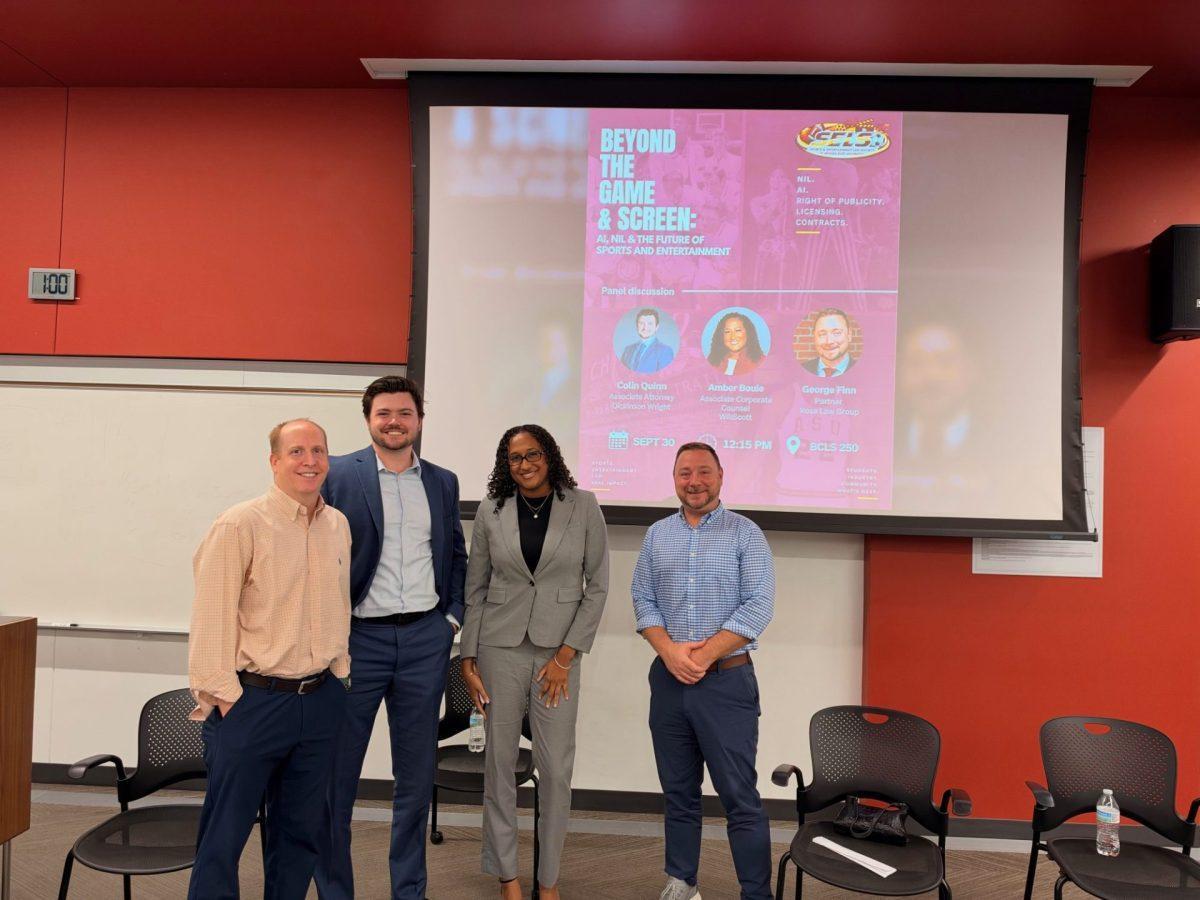
George Finn, Rose Law Group Partner and Senior Transactions, NIL and Estate Planning Attorney, tackled those issues during a recent Sports and Entertainment Law Society panel at Arizona State University titled “Beyond the Game & Screen: AI, NIL & The Future of Sports and Entertainment.”
The discussion was moderated by ASU Professor Jon Kappes, who will teach Right of Publicity Law next semester, and brought Finn together with professionals working across sports, entertainment and intellectual property law, including Colin Quinn, associate attorney at Dickinson Wright, and Amber Bouie, associate corporate counsel and NIL agent.
Finn brought a perspective shaped by decades in law and years representing professional athletes. He told the audience his interest in the field stretches back to wanting to become a sports agent after watching Jerry Maguire. Friends who went on to play in the NFL helped open doors to representing professional athletes early in his career.
Today, the legal landscape athletes enter looks dramatically different — particularly with NIL and increasingly accessible artificial intelligence.
When Kappes asked Finn about emerging challenges, Finn said AI can be useful in legal work, but cautioned against treating it as a replacement for an attorney’s judgment.
“I treat it as a second brain to shoot ideas and analyze different things,” Finn said, explaining that lawyers should rely on their own judgment while using AI for confirmation and further analysis.
Finn noted that receiving an AI-generated contract from the other side of a negotiation can sometimes even provide leverage when the technology produces mistakes, including miscited case law.
Bouie raised similar concerns from the athlete representation side, telling the audience that athletes are increasingly bringing her brand agreements they have already run through AI. But automated tools, she said, can overlook provisions with significant long-term consequences.
“The AI tool can read it, but it can miss those things that need to be digested,” Bouie said, pointing to a brand deal that sought rights to an athlete’s content for four years in exchange for two social media reels.
For Finn, those details matter because an NIL agreement should be viewed as much more than an immediate paycheck.
“The NIL is the seed that you can grow, the asset, over the course of years,” Finn said.
Young athletes can find themselves negotiating against corporations or collectives with substantial resources and sophisticated legal teams. Finn said the goal is to put the athlete in a position to grow, treating the athlete and the intellectual property surrounding their brand as a business asset that could become substantially more valuable if they turn professional.