
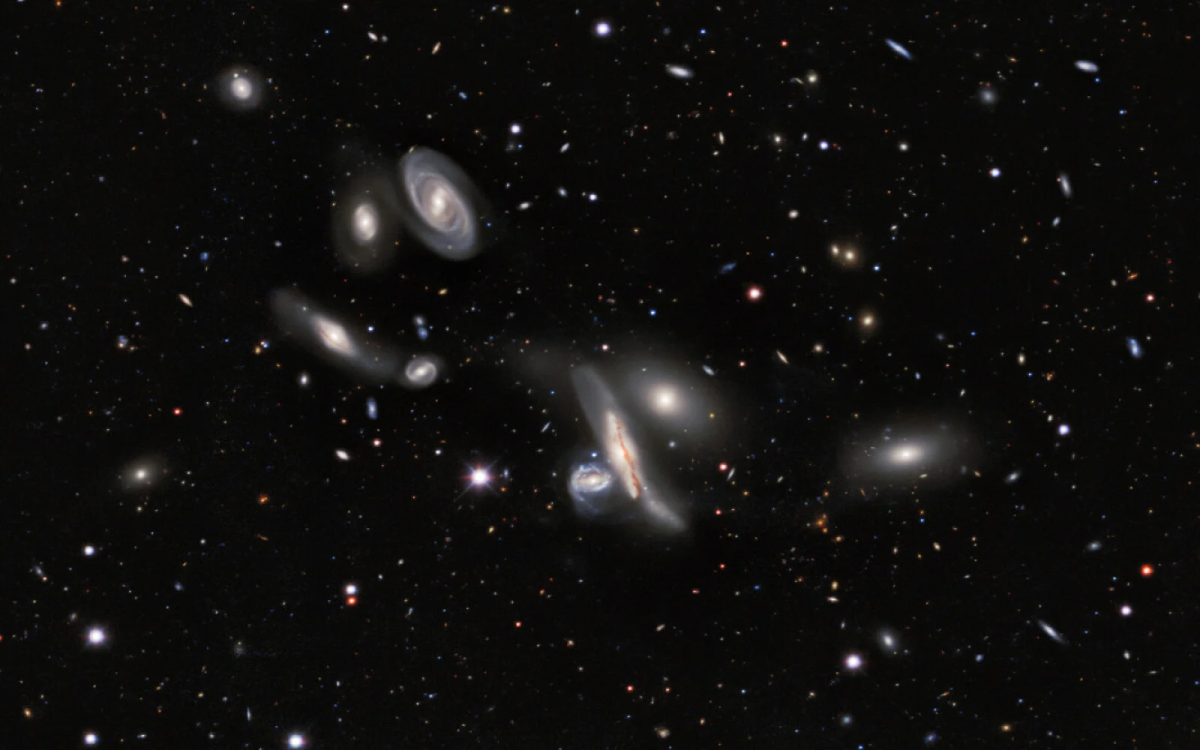

The Copeland Septet is a set of galaxies in the constellation Leo. This image was captured with the 570-megapixel Department of Energy-fabricated Dark Energy Camera (DECam) mounted on the U.S. National Science Foundation Víctor M. Blanco 4-meter Telescope at Cerro Tololo Inter-American Observatory (CTIO) in Chile, a Program of NSF NOIRLab. – Credit: DESI Legacy Imaging Surveys
By Lauren Biron | The National Energy Research Scientific Computing Center
Hold on to your telescopes: the DESI Legacy Imaging Surveys team has released the largest-ever 2D color map of the universe. The 5.6-trillion-pixel map contains nearly 4 billion celestial objects, primarily stars and galaxies. The data is available for all to use and publicly viewable through the Legacy Survey Sky Viewer.
Astronomers and citizen scientists can explore the map or combine it with their own observations to better understand our universe. Researchers can search for rare phenomena like gravitational lenses, observe fleeting events like supernovae, and investigate two of physics’ biggest mysteries: dark matter, the invisible substance that accounts for most of the mass in our universe, and dark energy, the force driving our universe’s accelerating expansion.
<iframe title=”vimeo-player” src=”https://player.vimeo.com/video/1216223130?h=9c7e7a7b7c” width=”640″ height=”360″ frameborder=”0″ referrerpolicy=”strict-origin-when-cross-origin” allow=”autoplay; fullscreen; picture-in-picture; clipboard-write; encrypted-media; web-share” allowfullscreen></iframe>
The new map builds on earlier versions from the DESI Legacy Imaging Surveys that have already proved invaluable. To date, more than 1,800 science papers that reference the Legacy Surveys data have been published.
“It’s part of the fabric of astronomy research now,” said David Schlegel, a co-lead of the Legacy Surveys and scientist at the Department of Energy’s Lawrence Berkeley National Laboratory (Berkeley Lab). “When you’re working with astronomical objects today, you often start by pulling up the Legacy Imaging Viewer to see what you’re looking at.”

Shruti Gurudanti, Rose Law Group partner and leader of the firm’s space law practice, tells RLGR:
“This map is a good reminder that the most valuable asset in the space economy right now is data, and space law hasn’t caught up nearly as fast to questions of data governance and access.”